

Tibbetts joined the Public Works Department in 1949, when he was appointed Superintendent of Works. At the time, the department was a remarkably small operation. A staff of just 12 was responsible for building and maintaining roads and government buildings, looking after lighthouses and telephones, maintaining the airport runway and government vehicles, assisting with mosquito control and supervising public works in Cayman Brac.
The conditions in which Tibbetts and his team worked bear little resemblance to modern road construction. According to accounts later recalled in the Legislative Assembly, the department began with only three wheelbarrows, a few picks and shovels and hand-beaters made from hardwood. Roads were built from marl dug by hand, while an early second-hand grader sent from Jamaica was originally designed to be pulled by mules and instead had to be hitched to a truck. When a road roller eventually arrived from England, one of the first places it was used was at the entrance to the airport.
Despite these limited resources, Tibbetts and his crews helped create and maintain the infrastructure needed by a country beginning a period of profound change. His work extended beyond roads to government buildings and other public facilities, and he was remembered as someone who was willing to work alongside the road gangs himself rather than simply supervise from a distance.
His service was recognised internationally in 1962, when Esterley Clarence Tibbetts, then Superintendent of Public Works, was awarded the British Empire Medal. As Cayman continued to develop and the Public Works Department expanded, he went on to serve as Deputy Director of Public Works.
Tibbetts formally retired in 1976 but continued working with the department for several years afterwards. Even in retirement, his practical experience remained valuable. In 1978, for example, he was recorded as the site foreman responsible for Public Works Department construction at George Town Primary School, part of a programme expanding school facilities to accommodate Cayman’s growing population.
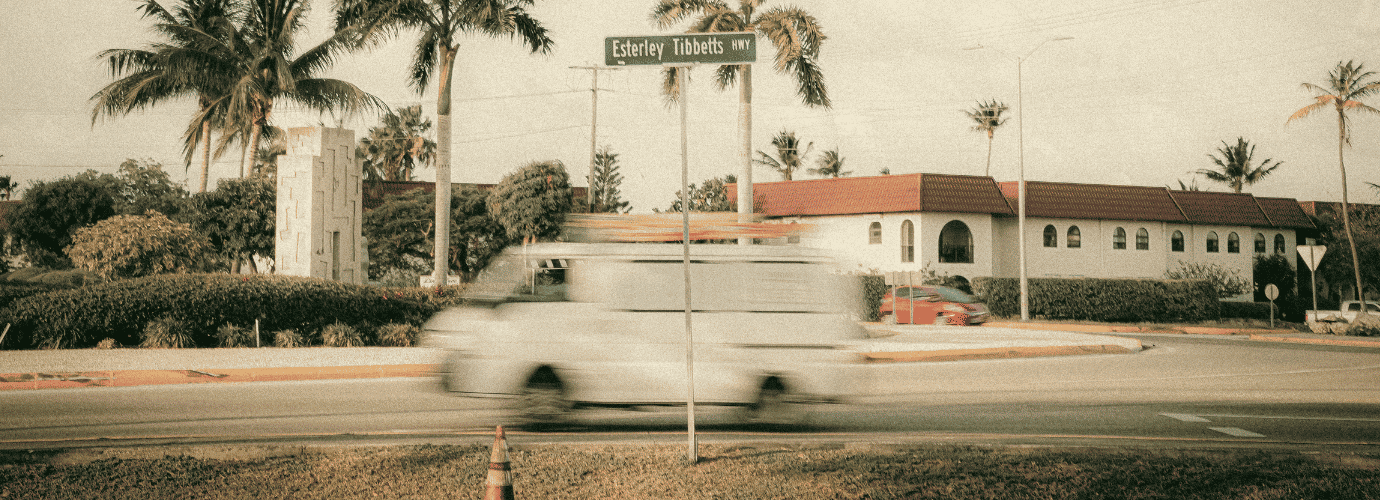
In 1999, members of the Legislative Assembly moved to ensure that Tibbetts’ contribution would be permanently remembered. A motion was introduced to rename the Harquail Bypass the Esterley Tibbetts Highway, with legislators recalling the years when he and his crews had built roads with little more than hand tools and determination. The road was named in recognition of his dedicated service to the Public Works Department and his contribution to the development of the Cayman Islands.
Esterley Tibbetts Highway therefore carries the name of someone who quite literally helped build modern Cayman. His career spanned the transformation from hand-built marl roads and a tiny Public Works crew to the beginnings of the modern infrastructure network Cayman relies on today. His legacy is found not only in the highway that bears his name, but in the roads, buildings and public works that helped connect the Islands and prepare them for the future.
Did You Know?
- Pete Tibbetts served as Deputy Chief Engineer in the Public Works Department.
- He helped develop Cayman’s roads, bridges, drainage systems and public buildings.
- Much of his work happened behind the scenes during Cayman’s rapid growth.
- Esterley Tibbetts Highway honours his role in literally helping build modern Cayman.